Women Behind the Camera
1848-1968
Hasselblad Center
23 May – 27 September 2026


Hasselblad Center
23 May – 27 September 2026
Women photographers have existed for as long as photography itself – and for a long time, they played a prominent role in the field. Around the turn of the twentieth century, in several Swedish cities, they even outnumbered their male counterparts. Then something happened. During the first half of the twentieth century, their presence diminished, and the profession came to be dominated by men. The myth of the male photographer grew, and women’s contribution to the history of photography remained unwritten – until now. The exhibition Women Behind the Camera, 1848–1968, opening on 23 May at the Hasselblad Center, presents their images and stories, many for the first time. A particularly fitting way to mark the 200th anniversary of photography.
The exhibition Women Behind the Camera, 1848–1968 is based on the book of the same title, which is the first major survey of women professional photographers in Sweden.
The book begins in 1848 with Amalie Motander, the first known woman photographer in Sweden, and concludes in 1968 – a year marked by global and cultural upheaval, when women’s liberation gained increased momentum and visibility. In between, it offers a chronological overview of the social, cultural and technological changes that shaped the conditions for women photographers.
The exhibition presents 24 photographers in depth, ranging from the photographer Bertha Valerius (1824–1895), who worked for the Swedish royal court, to the photojournalist Anna Riwkin-Brick (1908–1970). In addition, thematic sections explore genres such as self-portraiture, landscape, reportage, fashion, and advertising, featuring more women photographers. The selection reflects both geographical breadth – from northern to southern Sweden – and the diversity of the photographers’ practices. It includes portrait photographers and entrepreneurs who ran successful studios, some of Sweden’s first press photographers, and artists who experimented with photographic techniques.
The exhibition features vintage prints, that is, original prints produced by the photographers themselves, on loan from museums, archives and private lenders. However, most of the images are newly produced pigment prints. This is because much of the material exists only as glass negatives, which require digitisation to be exhibited. Many original prints are also extremely fragile. To make the subjects visible and to highlight the work of these photographers, new prints have therefore been necessary. The fact that archives of women photographers have often been forgotten or destroyed is also a key point of departure. As photography celebrates its 200th anniversary, this exhibition places Swedish women pioneers firmly within the history of photography.
Curator: Dragana Vujanović Östlind, in collaboration with photo historian Eva Dahlman and photographer Lena Wilhelmsson. Texts by Magnus Bremmer, media historian.
Exhibition tour
• The exhibition will be shown at the Hasselblad Center in Gothenburg, 23 May–27 September 2026.
• It will then travel to Fotografiska in Stockholm, where it will be on view from 4 December 2026 to 11 April 2027.
• Additional venues are planned through to 2028.
Facts
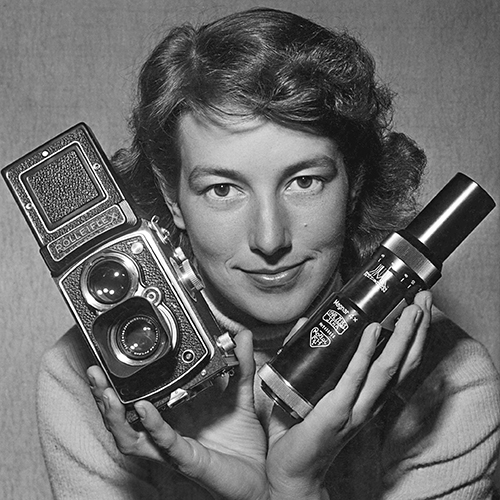
Image: Astrid Bergman Sucksdorff with a Rolleiflex camera and telephoto lens, c. 1950. Photo: Sven Gillsäter. Landskrona Museum.
Introduction
Carte-de-visite portraits
Views and landscapes
Self-portraits
Amateurs
Press photography and reportage
Fashion and advertising
Artistic photography
The Pioneer Years 1839-1860
The Breakthrough Years the 1860s
Studio owners 1860-1920
The New Woman, around 1900
Decline 1920-1945
A Second Generation 1945-1970